Star Wars Battlefront II: loot boxes and Reddit's revolt
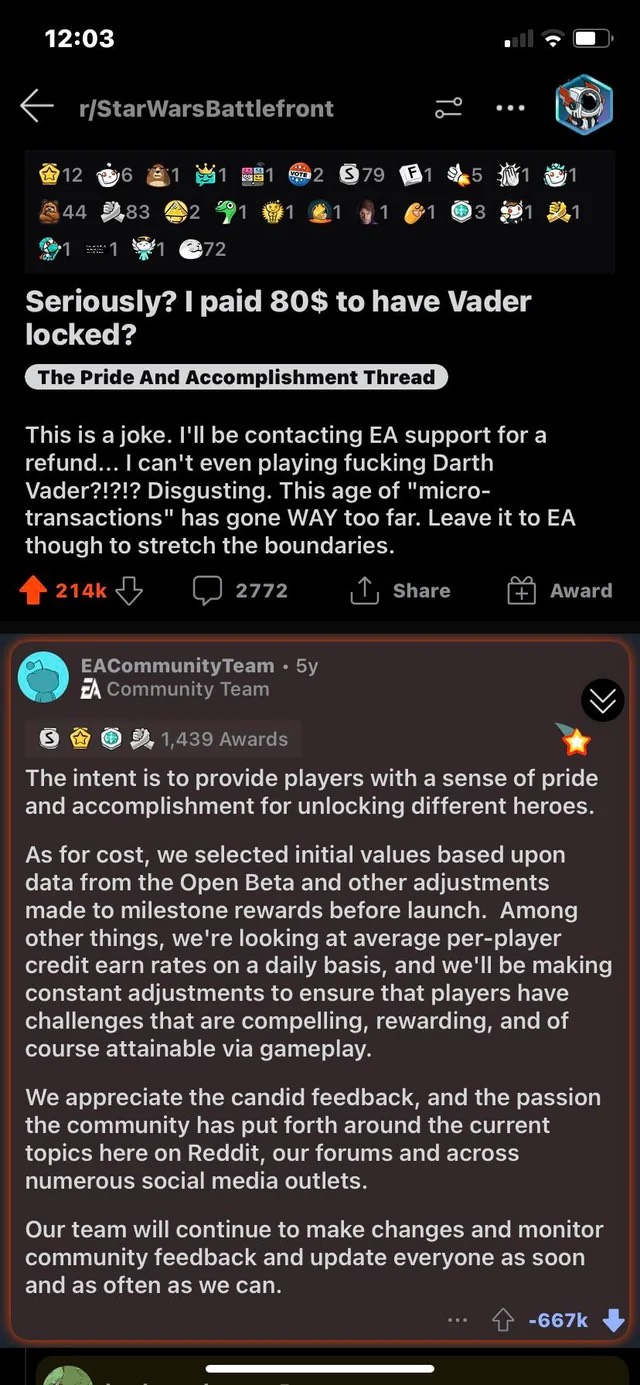
“The intent is to provide players with a sense of pride and accomplishment for unlocking different heroes.” EA’s community account posted that line under a thread from a player who had just paid 80 dollars for Star Wars Battlefront II, and within days it was the most downvoted comment in Reddit’s history. Behind the anecdote sits a loot box system: EA had to back down hours before a worldwide launch, Disney reportedly grew worried, and regulators got involved.
A Star Wars shooter released in the age of loot boxes
When Battlefront II launched on 17 November 2017 on PlayStation 4, Xbox One and PC, it carried some baggage. The 2015 Battlefront had been criticised for lacking a single-player story and for repetitive multiplayer; the sequel answered with a campaign and a promise of free content updates instead of a paid season pass. It sold for 60 dollars.
A loot box is a virtual crate with random contents, earned through play or bought with real money. The BBC points out how close that is to a slot machine: spend a small amount and you might get something useful, spend ten times as much and you might get nothing useful at all. In 2017, 60-dollar games such as Overwatch, Call of Duty: WWII and Middle-earth: Shadow of War already shipped with optional crate economies, and players often complain but buy anyway.
Star Cards, credits, crystals: how the economy worked
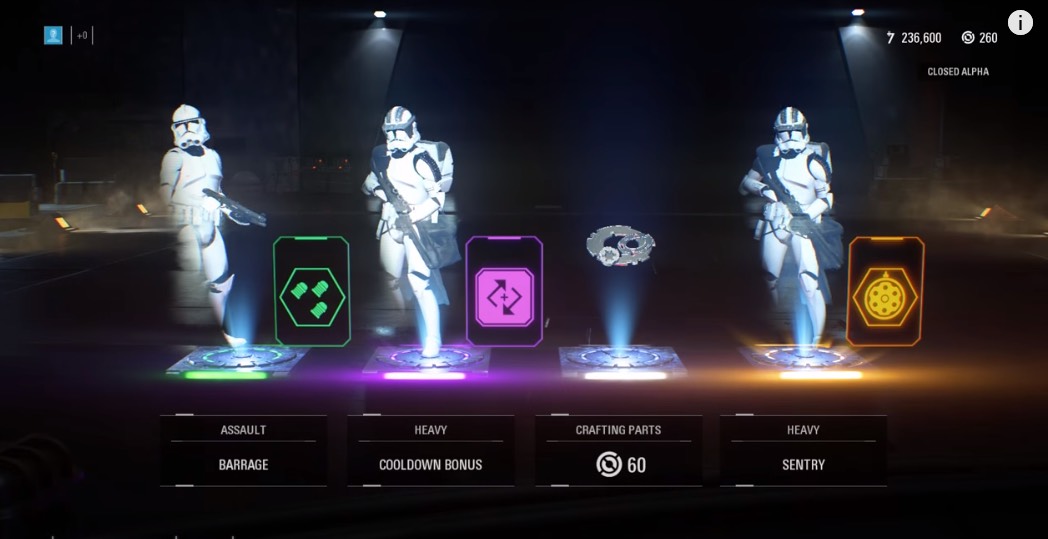
Battlefront II is first and foremost an online multiplayer shooter, where you earn ranks and resources for your classes and favourite characters. Progression revolves around Star Cards, which boost stats and grant new abilities across four rarity tiers: common, uncommon, rare and epic. Stacking cards for a class raises its level and opens better crafting options. Those cards, like weapons, cosmetics and other resources, mostly came out of randomised crates.
Two currencies fed the system. Crystals opened crates: you could buy them, from 4.99 dollars for 500 up to 99.99 dollars for 12,000, or earn them slowly through challenges and milestones. Credits, earned by playing, bought heroes, which crystals could not.
DICE insisted the game was not pay to win. Associate design director Dennis Brännvall said you should never be matched with players much better than you, and that effectiveness would come down to skill, not Star Cards. The beta, from 6 to 11 October 2017, gave many players a different impression: some cards were very strong (the Assault class one cut health regeneration delays by up to 40%) and epic cards could drop from crates, so you could buy your way to a high level. EA pulled epics out of the crates and moved them to crafting, but the worry about progression resting on a random element did not go away.
The spreadsheet that put a number on the grind
On 10 November, EA opened a ten-hour trial to EA Access and Origin Access members, with progress carrying over to the full game: for many, it was the first contact with the final economy. In the days before launch, a player going by TheHotterPotato posted a spreadsheet that did the maths. Credits depended on time played, not performance, so you needed 40 hours to unlock a character such as Chewbacca or Palpatine, and 60 hours for Luke or Vader, each. Whether you got 30 kills or 3 in a match, you walked away with the same credits. Hard to call that an accomplishment. The same subreddit later saw a second spreadsheet, about the credits challenges pay out, titled “You get a total of 32,400 credits from challenges”.
The sentence that made Reddit furious
A player then vented on the game’s subreddit after buying 12,000 crystals for 80 dollars (with the 10% EA Access discount), only to find that this currency could not buy heroes. Darth Vader cost 60,000 credits. EA’s reply added that prices had been set from beta data and would be adjusted continuously.
The community’s verdict came fast. According to Vice, the comment already had more than 280,000 downvotes in under 24 hours, far ahead of the previous record, around 24,000, held by a user who had literally asked for it. GameSpot later puts the total at over 675,000. In the same thread, players were organising a boycott and a campaign to cancel pre-orders. On the screenshot below, taken years later, the counter still reads -667k.
Less than a week to make EA back down
EA reacted in stages. On 13 November the studio announced a 75% cut in hero costs: Luke and Vader dropped to 15,000 credits, Palpatine, Chewbacca and Leia to 10,000, Iden to 5,000. Right after, the campaign completion reward fell from 20,000 to 5,000 credits to stay in line with Iden’s new price.
Press reviews arrived in the meantime, with lukewarm scores: 6 out of 10 at GameSpot, 6.5 at IGN. The game was fun, but the crates weighed on the verdict. EA, for its part, told GameSpot that its crate mechanics were not gambling, while its finance chief asked players to be patient.
Then, a few hours after an AMA in which DICE developers promised to fix the problem, every in-game purchase vanished. DICE general manager Oskar Gabrielson apologised: “Sorry we didn’t get this right.” Buying crystals would come back later, after changes. IGN and GamesIndustry.biz carried the same announcement, on the eve of the 17 November launch.
Another party reportedly tipped the scales. According to the Wall Street Journal, as relayed by IGN and Windows Central, Disney, which owns the licence, grew concerned and contacted EA. I don’t know what was actually said, but the timing is suggestive.
From the forum to the regulators
The scandal soon left Reddit. On 22 November, Hawaii lawmaker Chris Lee called the game a “Star Wars-themed online casino designed to lure kids into spending money”.
In Belgium, the gaming commission investigated four titles: FIFA 18, Overwatch, Counter-Strike: Global Offensive and Battlefront II. In April 2018 the first three were found in breach of gambling law, with a possible 800,000 euro fine and up to five years in prison for publishers. Only Battlefront II escaped the ruling, because EA had meanwhile switched microtransactions off. The publisher first refused to comply for FIFA, then removed the disputed content once a criminal investigation was opened, according to a European Parliament study.
What the scandal cost
In late January 2018, EA confirmed 9 million copies shipped in the launch quarter, against 13 million for the 2015 Battlefront and 10 million in its own models. Its finance chief admitted the game had disappointed: the quarter fell less than a million units short of an 8 million sales target, which would put the total just over 7 million. Shipped is not sold, which explains the gap between the two figures. EA added that players were spending twice as much time in the game as in the first one, and that microtransactions would return “in the next few months”.
On the Disney side, Bob Iger said in 2019 that the relationship with EA remained “good”. The partnership held.
Battlefront II’s late redemption
On 21 March 2018, the progression update unlocked every hero, and Mashable describes a new linear system without paid loot boxes. A real U-turn, even if it came four months after the fact.
On 23 June 2025 the game broke its concurrent-player record on Steam with 35,892 players online, while on sale for 4 dollars. GameSpot floats the Andor series as a possible cause, though where the surge came from is not settled.
The story echoes other cases where the community acted as a counterweight, such as the Watch Dogs graphics downgrade. Here, the money spent inside the game was what was at stake. Knowing what you paid for, and where, across PlayStation 4, Xbox One or PC, is a mundane need that Radion tries to cover by gathering your libraries in one place. It won’t tell you whether a game’s economy is fair; that’s still for you to sense. In this affair, a player’s spreadsheet carried more weight than any press release.